


Your Yin Body through Fascia
Lately, I’ve been fascinated by fascia… and I’m not the only one. The online world has been flooded with content about connective tissue. Everything from how to release it, to the way it holds tension, to how you know if your pain is fascial, muscular, or a little bit of both.
Before we go any further, let’s define fascia.
Fascia is a connective tissue that holds the body in place. There are several layers, each with a slightly different job:
- Superficial fascia lies just beneath the surface of your skin. It creates a cushion against injury, stores fat, and helps regulate body temperature.
- Deep fascia goes a little deeper, wrapping around your muscles, bones, nerves, and blood vessels.
- Parietal fascia lines the body’s cavities, including the thoracic, abdominal, and pelvic cavities.
- Visceral fascia wraps around your organs, helping hold them in place within those cavities.
Together, these layers create a continuous web of connective tissue throughout the body.
Fascia also plays an important role in how we move. Rather than thinking about each muscle as working completely on its own, we can look at the continuous pathways of muscles and fascia that connect different parts of the body.
Thomas Myers, an integrative structural therapist and author of Anatomy Trains, popularized a framework for mapping these pathways. His myofascial lines can be used to look at patterns of movement and tension throughout the body.
Some travel from the head all the way down to the feet. Some run along the front, back, and sides of the body. Others spiral, crisscross, or extend through the arms. Each line connects a unique set of muscles and movements.
The myofascial lines are like a map for patterns of movement and tension in the body. Not unlike my other favorite body map:
The meridians.
In that realization, I found my newest obsession. How myofascial lines interact with the meridians.
That’s what this series is all about. In it, we’ll explore the fascia through the meridians and answer questions like:
Where do these two maps intersect? What can we learn by comparing them side by side? And can we learn anything about patterns of physical and energetic tension by looking at both together?
We’ll start deep inside the body with the Deep Front Line.

The Deep Front Line
Anatomy Trains describes the Deep Front Line as the myofascial core. It begins on the bottom of your feet, travels up the inner leg, passes through your pelvic floor, torso, front of the spine, and connects into the throat, jaw, and tongue.
If we follow the Deep Front Line description, we can also point to several meridians that pass through or follow it for a time. The Kidney, Liver, and Spleen meridians all pass through the inner thighs. The Lung, Pericardium, and Heart intersect with the line in the torso and chest.
But it’s the Conception Vessel that traces this fascial line most closely. It runs from the pelvic floor up into the throat and lower lip.
Because of this, I like to think of the Deep Front Line as the Yin Body.
In TCM, the Conception Vessel is known as the Sea of Yin, guarding your body’s ability to receive, flow, and tap into the rest-and-digest part of your nervous system.
Yin is your energy reserves, and yang is your body’s use of that energy. It’s potential, rather than action. Rest, contraction, meditation.
The Deep Front Line takes us into the deepest parts of the body. Here, the fascia doesn’t just wrap and connect muscles. Visceral fascia surrounds, supports, and suspends our internal organs, allowing them to move in relationship with one another as we breathe, digest, twist, and move.
And this gives us another interesting connection to the meridians. Each of the primary meridians is traditionally associated with an internal organ or organ system. The Kidney meridian is associated with the kidneys, the Liver with the liver, the Spleen with the spleen, and so on. So as we move deeper into the fascia, we can explore the meridians not only through the muscles and pathways they intersect, but through the organs they’re associated with.
The deeper we follow this line, the more we move into Yin territory: the inner body, the organs, our energy reserves, and the systems that support us behind the scenes.
The Yin Body
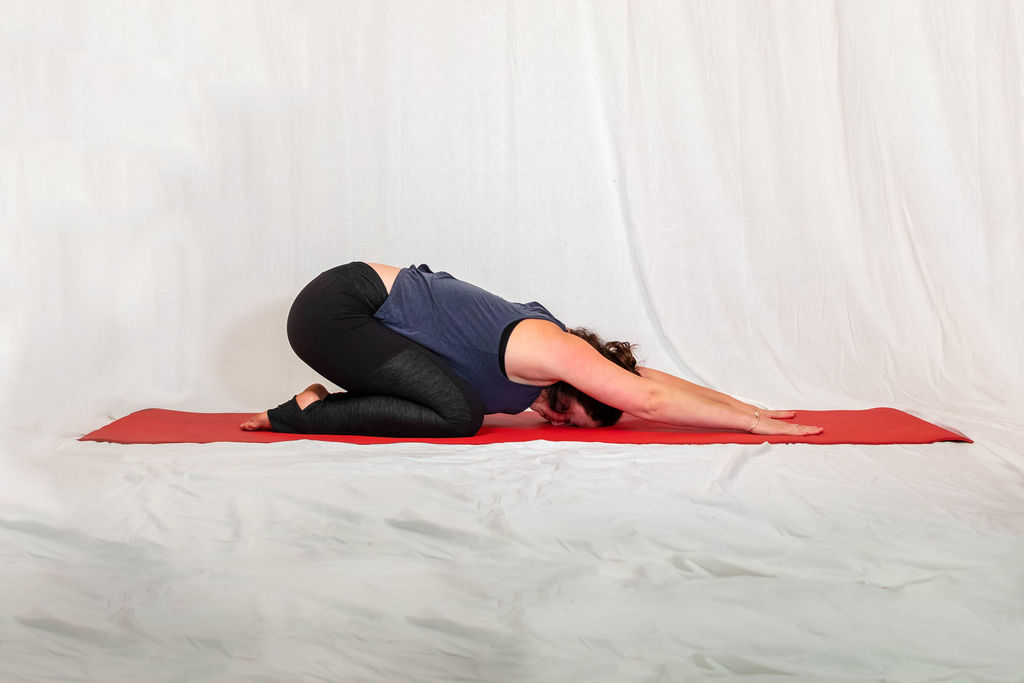
As a yoga teacher, I always think of Yin as a forward fold.
Once, when I was in a slow yoga class, the teacher put the class into a forward fold and left us there. While we struggled against the tightness in our hamstrings, she talked to us about how curling forward helped us to look inward. How our breath had to press deeper to fill us up. How when we block off the outside world by tucking our chins and looking down, our attention naturally shifts to our inner world.
The front of the body is our softest part. It houses our most vulnerable parts. When threatened, most of us will instinctively protect it, curling in and down into the fetal position.
When we do so, we are also protecting the Deep Front Line.
The Deep Front Line passes through some of the most complex structures in our bodies. The inner legs, pelvic floor, psoas, diaphragm, spine, and jaw. So many people struggle with tension or pain in these areas. And if you’ve ever tried to release it, you know how difficult it is to release tension from such vulnerable areas.
These areas are so deep, and their holding so instinctual, that most of the time, you may not ever realize you’re holding there in the first place.
Tension in the Deep Front Line tells us a bigger story about our relationship with the yin body: with safety, with receiving, with holding ourselves together in the face of the world.
When we are in balance, feeling safe, at ease, and allowing ourselves to receive from life, the Deep Front Line knows it doesn’t have to hold so tightly.
And maybe the meridians can help us understand which systems, emotions, or areas of our lives are contributing to that holding.

The Meridians of the Deep Front Line
Each meridian that intersects the Deep Front Line brings a different piece of the story.
Kidney: Your Reserves
The kidney meridian travels up the inner foot and leg, through the medial quadriceps, into the pelvic floor, before moving up into your myofascial core.
In TCM, the kidney is related to fear, and specifically, our deep seated fears around survival. This meridian goes out of balance when you are struggling to survive on a very basic level. If you don’t feel safe, if you don’t have the energy to keep going, if you’re constantly in fight-or-flight, your kidney meridian is probably out of balance.
The Kidney meridian is also deeply Yin, associated with potential energy, rather than action. It stores Jing, or Essence, one of your body’s deepest reserves. One of the core Yin principles is that you have to have something in reserve in order to spend it. Like savings, if your Jing or Essence runs low, you are going to have more fear around survival because you know there isn’t a cushion to fall back on when you need it.
To bring balance to the Kidney, you can work with the physical pathway with resistance exercises that activate the muscles along the meridian line (in this case, the medial quads) or release fascia along the Deep Front Line.
Energetically, you can regulate your nervous system, cultivate feelings of safety, and practice receiving without immediately giving or spending. Let yourself hold rest, support, nourishment, time, money, or energy simply to build up your reserves.
Liver: Resistance for Resistance Sake
The Liver meridian runs up the inner thigh, through the adductors, into the pelvic floor, and up through your myofascial core.
In TCM, the Liver is related to anger and frustration. In particular, this frustration is related to suppression and avoidance. When we are struggling to trust the natural flow of life, fighting tooth and nail against what is, or resisting simply for the sake of resisting, your Liver meridian is probably out of balance.
The Liver meridian is yet another Yin meridian, but unlike the Kidney, which is concerned with our reserves and survival, the Liver meridian is about flow, trust, and receiving. Yin is not meant to stagnate. It receives and gathers, but that energy eventually has to move. When we fall into a holding pattern, keeping things in rather than letting them flow, frustration and anger are the result.
To bring balance to the Liver, you can work with the physical pathway with resistance exercises that activate the muscles along the meridian line (in this case, the adductors) or release fascia along the Deep Front Line.
Energetically, you can find healthy releases for frustration and practice receiving what is before deciding what to do about it. Notice where you immediately resist, suppress, control, or push against what is, and experiment with pausing and letting the experience move through you before you react.
Spleen: Digestion and Receiving
The Spleen meridian travels up the inner leg, through the medial hamstrings, and into the abdomen, closely paralleling portions of the Deep Front Line.
In TCM, the Spleen is related to worry, overthinking, and our ability to digest not only food, but experiences. When we are constantly thinking, planning, analyzing, or trying to hold everything together, we can struggle to actually receive and process what is happening.
The Spleen shows us another side of Yin: nourishment. Receiving is not just about letting something come to you. You also have to be able to take it in. You can eat the healthiest food in the world, but it doesn’t do much good if you can’t digest it. The same is true of support, information, experiences, and emotions. At some point, we have to stop chewing and let ourselves digest.
To bring balance to the Spleen, you can work with the physical pathway with resistance exercises that activate the muscles along the meridian line (in this case, the medial hamstrings) or release fascia along the Deep Front Line.
Energetically, practice receiving something without immediately analyzing what it means or what you need to do with it. Let someone help you. Accept the compliment. Eat without multitasking. Give yourself enough space to actually digest what you have already taken in before reaching for more.
Lung: Letting Go
The Lung meridian begins internally in the torso before moving through the chest and down the inner arm. Its internal pathway brings us into the chest and diaphragm, another important area of the Deep Front Line.
In TCM, the Lung is associated with grief, breath, and letting go. When we brace against life, one of the first things that changes is often our breath. We hold it. Shorten it. Tighten through the chest and diaphragm as if keeping ourselves contained could somehow keep the experience contained, too.
The Lung gives us another piece of the Yin puzzle: receiving requires letting go. You cannot endlessly inhale. Eventually, you have to exhale. We need space inside ourselves for something new to enter, and sometimes creating that space means releasing something we have been holding onto.
To bring balance to the Lung, you can work with the physical pathway with resistance exercises that activate the muscles along the meridian line (in this case, the pecs, delts, and biceps), breathwork, or release fascia along the Deep Front Line.
Energetically, explore what you are ready to let go of. Grief, expectations, old identities, relationships, possessions, ideas about how something was supposed to happen. Practice the rhythm of receiving and releasing rather than gripping tightly to either one.
Heart: Staying Open to Life
The Heart meridian begins in the chest before traveling through the armpit and down the inner arm. Its internal pathway brings us back into the chest and the vulnerable front of the body.
In TCM, the Heart is associated with joy, connection, and our emotional and spiritual life. The Heart brings openness into the Yin Body. To receive life, we have to remain open enough to actually be affected by it.
But openness also makes us vulnerable. When being affected by life has hurt us before, it makes sense that we might close ourselves off. We protect the chest. We guard our emotions. We stop letting things in. But when we close ourselves to pain, we often close ourselves to joy, intimacy, and connection at the same time.
To bring balance to the Heart, you can work with the physical pathway with resistance exercises that activate the muscles along the meridian line (in this case, also the biceps) or release fascia along the Deep Front Line.
Energetically, notice where you have closed yourself off because staying open feels too vulnerable. Practice letting yourself be moved by something. Beauty. Affection. Joy. Connection. Receiving doesn’t always mean taking something in and keeping it. Sometimes it means allowing yourself to be touched by life.
Pericardium: Softening Our Protections
The Pericardium meridian begins deep in the chest before traveling through the center of the inner arm. Like the Heart, its internal pathway brings us into the upper territory of the Deep Front Line.
If the Heart represents vulnerability, the Pericardium represents protection around that vulnerability. Physically, the pericardium is the sac surrounding the heart. Energetically, the Pericardium gives us a way to explore the protections we build around our own hearts.
Protection is not inherently a problem. We need boundaries. We need discernment. We need to know when something is not safe to receive. But protection can become holding. The armor that once kept something out can eventually make it difficult for anything to get in.
To bring balance to the Pericardium, you can work with the physical pathway with resistance exercises that activate the muscles along the meridian line (in this case, the pecs and biceps) or release fascia along the Deep Front Line.
Energetically, explore the difference between protection and bracing. Where do you genuinely need a boundary, and where are you protecting yourself out of habit? Practice softening the protections you no longer need without abandoning the ones that keep you safe.
Conception Vessel: Creating from Flow
The Conception Vessel runs directly up the center of the front body, beginning at the pelvic floor and traveling through the abdomen, chest, throat, and lower lip. Of all the meridians we’ve explored, its pathway most closely follows the central territory of the Deep Front Line.
In TCM, the Conception Vessel is known as the Sea of Yin. Rather than being associated with a single organ, it helps regulate and connect the Yin meridians and brings us into some of the deepest, most receptive parts of the body.
For me, the Conception Vessel represents the God or Goddess energy of the body. It is our capacity to create, feel, intuit, embody, and allow life to move through us rather than constantly trying to direct it. This is Yin not as passivity, but as creation. We receive, gather, gestate, and eventually something new emerges.
To work with the Conception Vessel physically, you can explore the Deep Front Line itself, particularly the pelvic floor, abdomen, diaphragm, chest, throat, and other structures along the center of the body.
Energetically, explore your relationship with softness, sensuality, creativity, femininity, and simply being rather than doing. What happens when you stop trying to force the next thing into existence? What wants to be created when you give yourself enough space to receive it first?
—
The Deep Front Line gives us a physical way to see how interconnected these deeper systems really are. Tension rarely exists for no reason. The inner legs connect into the pelvis, the pelvis into the psoas and diaphragm, and the diaphragm into the spine, chest, neck, and jaw.
And the same is true energetically.
If the Deep Front Line represents some of the deepest, most Yin parts of ourselves, then tension here may allow us to explore what we’re holding beneath the surface.
The meridians give us another lens through which to look at our imbalances. Each of the yin meridians that intersects with the Deep Front Line carries its own energetic themes, its own archetypal lens. When we look at the whole picture, rather than just the parts, we are that much closer to finding out why we’re holding.
Signs Your Deep Front Line Might Need Some Attention
Because the Deep Front Line travels through so many deep structures of the body, tension here can show up in several different ways. And if we’re looking at it through the meridians as well, we can explore both the physical and energetic patterns that might be asking for our attention.
Physical signs might include:
- Flat feet or overpronation
- Foot cramps
- Toe gripping
- Inner knee strain
- Adductor tightness
- Groin tightness or pain
- Hip or psoas tension
- Pelvic floor tension
- Low back compression
- Feeling compressed or restricted through the abdomen
- Difficulty taking a full, relaxed breath
- Diaphragm or rib tension
- Persistent tension through the neck, throat, or jaw
- Feeling like you’re constantly bracing or holding your body together
- Difficulty fully relaxing, even when you’re stretching
Energetic signs might include:
- Feeling unsafe or chronically on guard
- Difficulty receiving help, support, rest, or pleasure
- Feeling depleted even though you keep pushing yourself
- Worrying, ruminating, or feeling responsible for holding everything together
- Feeling stuck or frustrated when you want to move forward
- Protecting yourself from vulnerability or connection
- Difficulty letting go of grief, emotions, or experiences
- Feeling disconnected from your intuition, sensuality, or creativity
- Being much more comfortable doing than simply being
Think of these signs as clues. If several resonate, you might get curious about where you’re holding physically, which meridian themes feel familiar, and what happens when you begin working with those areas.
If you need guidance, Infinity Flexibility currently offers in-person sessions at our office in Natick, MA, or you can follow us on YouTube for fascia releases, self-stretches, resistance exercises, philosophical discussions, and more!
Working with Your Meridians
We can work the muscles along the meridian line to release tension in the fascia. We can release the fascia planes to support our meridians. We can go to acupuncture or Infinity for support from a professional. We can use our diet and lifestyle to support the physical body, which in turn supports us energetically. We can work on our nervous system to activate rest-and-digest.
We are not powerless. The more connections we can see, the more ways we have to create change.
If you are curious about fascia and the energy behind the meridians, make sure you follow along.
Energetics of the Deep Front Myofascial Line
