


Your Yang Body through Fascia
Lately, I’ve been fascinated by fascia, and I’m not the only one. The online world has been flooded with content about connective tissue. Everything from how to release it, to how it holds tension, to how you know if your pain is fascial, muscular, or a little bit of both.
Before we go any further, let’s define fascia.
Fascia is connective tissue that helps support and connect the structures of the body. There are several layers, each with a slightly different job:
- Superficial fascia lies just beneath the surface of your skin. It creates a cushion against injury, stores fat, and helps regulate body temperature.
- Deep fascia wraps around your muscles, bones, nerves, and blood vessels.
- Parietal fascia lines the body’s cavities, including the thoracic, abdominal, and pelvic cavities.
- Visceral fascia wraps around your organs, helping hold them in place within those cavities.
Fascia also plays an important role in healthy movement. Healthy fascia helps us move smoothly and comfortably, while restrictions in the fascia can contribute to tension, pain, and limited mobility.
We’re used to thinking about the parts of the body as separate from one another, each muscle, tendon, or organ working independently. But when we look at fascia, we begin to see just how interconnected the body really is. Not only are these structures connected, but what happens in one area can influence what’s happening somewhere else.
Thomas Myers, an integrative structural therapist and author of Anatomy Trains, popularized a framework for mapping these connections.
Some of these myofascial lines travel from the head all the way down to the feet. Some run along the front, back, or sides of the body. Others spiral, crisscross, or extend through the arms. Each line connects a unique set of muscles and movements.
The myofascial lines are a map for the patterns of movement and tension in the body.
Kind of like my other favorite body map:
The meridians.
In Traditional Chinese Medicine (TCM), meridians are pathways through which Qi, or vital energy, moves. Each meridian has relationships with particular organs, physical functions, emotions, and psychological patterns.
When we compare these two maps, we find some interesting intersections.
And that’s what this new Fascia and the Meridians series is all about.
Here we’ll answer questions like:
Where do the meridians follow the same pathways as the myofascial lines? What can we learn by comparing them side by side? And how can we use this knowledge to explore the connections between physical tension, emotional patterns, and energetic imbalances?
In our previous article, we explored the Deep Front Line and its relationship with Yin energy, receiving, and the body’s internal reserves.
Now we’re turning our attention to the back of the body.

The Superficial Back Line
The Superficial Back line begins in the plantar fascia on the bottoms of your feet. It travels up the backs of your legs through the calves and hamstrings, crosses the sacrum, and continues through the muscles and fascia along the spine. From there, it travels through the suboccipital muscles at the base of the skull and continues over the scalp toward the eyebrows.
This long myofascial pathway connects some of the body’s most important structures for posture, extension, stability, and movement.
When these structures work together, they help us stand upright, maintain balance, bend forward and stand back up, and move through the world with strength and stability.
But when tension develops along the Superficial Back line, it isn’t always confined to one area.
Tight calves can influence movement through the ankles and knees. Restricted plantar fascia can affect your pelvic floor. Tension along the back and neck can influence how we hold our heads and shoulders.
This is one reason we explore the myofascial line as a whole rather than focusing on the specific area where we feel sensation, discomfort, or pain. The root of that discomfort may not be where it hurts, but somewhere else on the line.
Energetically, the back of the body has long been associated with Yang energy.
Interestingly enough, two meridians have particularly strong connections to the Superficial Back line, and both are associated with Yang.
The Bladder meridian closely follows the back body, traveling from the head down the spine and backs of the legs to the little toe.
The Governing Vessel (also called the Brain Meridian in our framework) travels along the midline of the back and over the head. In Traditional Chinese Medicine, it’s known as the Sea of Yang because of its relationship with the body’s Yang channels, including the Bladder.
Several other meridians intersect with or relate to the Superficial Back line, including the Small Intestine, Kidney, and Skin/Triple Warmer.
The deeper we explore this line, the more we move into Yang territory: the spine, supporting muscles, and systems that help us protect ourselves and our loved ones.

The Yang Body
For six years, I worked as a part-time billing coordinator and part-time massage therapist at a chiropractor’s office. Six years during which I learned a lot about back pain and spine health. Six years watching people come into the office hunched over, listing sideways, cringing as though they were carrying the weight of the world, and walk out taller, more open, lighter than air.
If there’s one thing I took away from my time at the chiropractor, it’s this:
Healthy movement begins and ends with a healthy spine.
Your back is a source of strength and support. When another part of your body is struggling, your spine often steps in to share the load. And when your spine is struggling, the rest of your body has to adapt.
Most of us don’t realize just how much we rely on our spines until something goes wrong.
The Superficial Back Line connects many of the structures that help us stand upright, maintain balance, and move through the world. The muscles and fascia along this pathway support the spine, pelvis, and legs as we bend, extend, and respond to the demands of everyday life.
I like to think of the Superficial Back Line as the Spine of Yang.
In Traditional Chinese Medicine, Yang is associated with movement, activity, warmth, transformation, and outward expression.
If Yin represents our inner world, full of thoughts, desires, emotions, beliefs, and potential, Yang is the outward expression of that inner world. It’s how we turn our thoughts into actions, our desires into reality, and our boundaries into something more than words.
Yang gives us the strength to stand up, move forward, protect ourselves, and engage with the world around us.
But there’s an important distinction between having the strength to support yourself and feeling like you have to brace yourself against everything.
A healthy spine needs both strength and flexibility, stability and movement. It needs to support us against gravity while allowing us to bend, twist, extend, and adapt.
And the same is true of Yang energy.
Protection doesn’t always mean putting up walls or preparing for everything that could go wrong. Sometimes, the greatest protection comes from having the strength, resources, and self-trust to respond to whatever life brings.
Tension along the Superficial Back Line gives us an opportunity to explore our relationship with the Yang Body: with strength, security, protection, and the ways we brace ourselves against the world.
And maybe the meridians can help us understand which systems, emotions, or areas of our lives are contributing to that tension.

The Meridians of the Superficial Back Line
Each meridian associated with the Superficial Back Line brings a different piece of the story.
Bladder: Protection Without Bracing
The Bladder meridian begins near the inner corner of the eye, travels over the head, down the muscles that run parallel to the spine, through the backs of the legs, and ends at the little toe. Of all the meridians associated with the Superficial Back Line, the Bladder follows it the most closely.
In TCM, the Bladder is the Yang to the Kidney meridian’s Yin. Both meridians share themes related to fear, survival, and security. The easiest way to think of these meridians in terms of safety is that the Kidney represents our energetic reserves, and the Bladder represents our ability to use those reserves to protect ourselves and others. Without the ability to receive (Yin), we won’t have the energy we need to act when we need to (Yang). Both energies are essential for protection, neither more important than the other.
Protection doesn’t mean putting up harsh boundaries or staying braced just in case. We are not meant to remain constantly vigilant. A spine that can move between flexibility and stability provides better support than one that is constantly rigid. And action is most effective when it’s done from a place of ease rather than force.
The lesson of the Bladder meridian is to find balance between rest and action, saving and spending. And more importantly, to trust that we will know when to act and what action to take.
To bring balance to the Bladder meridian, you can work with resistance exercises that activate the muscles along the meridian pathway, particularly the lateral hamstrings and muscles along the spine, or explore fascia releases along the Superficial Back Line.
Energetically, explore your relationship with safety, security, and protection. Where in your life are you staying braced, waiting for the other shoe to drop? Are you confusing being prepared with being on guard? If so, your work lies in relearning trust. Trust that when a problem comes up, you will know what to do and you will act in the best way you know how.
Kidney: Your Foundation of Security
Although the Kidney meridian is more closely associated with the Deep Front Line (inner leg and front of the body), its relationship with the Bladder meridian makes it an important part of our exploration of the Yang Body.
In TCM, the Kidney is associated with Jing, or Essence. Basically, our body’s deepest reserves of energy. These reserves are essential for taking action, responding to life, and protecting ourselves. If we don’t have any energy reserved, we have no energy to spend. And without any energy to spend, how are we supposed to feel safe?
When we are exhausted, overwhelmed, burnt out, even the smallest action can feel overwhelming. The Kidney’s lesson is about knowing how much we have to give, and when we need to take time away to replenish our reserves.
To bring balance to the Kidney, you can do resistance exercises that activate the muscles along the meridian line, particularly the medial quadriceps, while exploring the relationship between the pelvic floor, low back, and spine.
Energetically, explore where your reserves feel depleted. Are you asking yourself to show up for others in a way you can’t show up for yourself? Can you give yourself time to recover when your reserves are depleted? If not, your work lies in remembering that you can only give to others that which you give to yourself first.
Skin/Triple Warmer: Creating Healthy Boundaries
The Skin meridian is most closely associated with the Triple Warmer from Traditional Chinese Medicine. Its path travels along the outer arm, shoulder, neck, and side of the head. Energetically, it speaks to our boundaries. In particular, how we relate to and interact with our environment.
Physically, our skin is the barrier between our internal body and the world around us. The Skin/Triple Warmer meridian (Yang) is balanced by the Pericardium meridian (Yin), which is more concerned with protecting our potential, beliefs, and internal world.
Energetically, the boundaries represented by the Skin meridian are all about how much of ourselves we share with others and what we allow to penetrate past the surface.
We don’t need rigid boundaries to do this. The lesson of the Skin meridian is learning how to protect ourselves without shutting out every new person or experience. Issues arise when we struggle to speak up for ourselves, take responsibility for someone else’s emotions, or become so defensive that genuine connection feels like a threat.
To bring balance to the Skin/Triple Warmer, you can work with resistance exercises for the muscles along the skin meridian line including your deltoids, trapezius, and triceps, as well as explore fascia releases for the upper back, shoulders, and neck.
Energetically, notice where you struggle with setting healthy boundaries. Can you say what you need to say without worrying too much about how someone will react? Can you remain connected to yourself when you’re around unfamiliar people or in new places? Do you know when to let someone in and when to keep your distance? If you struggle with boundaries, your work is to practice protecting your energy without closing yourself off from the world.
Small Intestine: The Power of Discernment
The Small Intestine meridian travels along the outer edge of the hand and arm, through the shoulder and scapular region, and up the neck toward the face.
In TCM, the Small Intestine is the Yang counterpart to the Heart meridian. Where the Heart opens us up to receive connections and experiences, the Small Intestine helps us decide what to do with everything we decide to take in. Its job (physically and energetically) is to separate the pure from the impure.
The lesson of the Small Intestine is all about discernment. Not everything we encounter deserves a place in our lives. Not every opinion deserves our attention. Not every problem is ours to solve. And not every uncomfortable experience represents a threat to our safety.
The Small Intestine teaches us that just because we are offered something doesn’t mean we need to take it. We need to be able to sort through our experiences and decide what is useful, what belongs to us, and what we’re ready to let go of.
To bring balance to the Small Intestine, you can work with resistance exercises that activate the muscles along the Small Intestine meridian line including the Infraspinatus and Supraspinatus, and explore fascia releases around the shoulder blades and upper back.
Energetically, practice distinguishing between what matters to you right now and what matters to the person you’re becoming. Are you taking too much responsibility for things that don’t belong to you? Are you saying yes to everything even when it drains you? Where in your life do you struggle to say, “Enough is enough”?
Discernment takes practice. It’s learning to recognize what deserves your energy, what doesn’t, and when it’s time to let something go.
Brain/Governing Vessel: Trusting Yourself to Respond
Finally, we come to the Brain meridian/Governing Vessel and the Sea of Yang.
The Governing Vessel travels along the midline of the back body, beginning in the pelvis, ascending the spine, and continuing over the head. Its pathway follows the central territory of the Superficial Back Line.
The Brain is the primary Yang meridian. It also has a close relationship with the spine, brain, and nervous system.
While Feminine/Yin energy is the domain of intuition and receiving, Masculine/Yang energy is typically associated with reason and action. Our ability to think ahead, anticipate problems, and plan our responses is one of the ways we use Yang energy to protect ourselves.
Our minds are really good at finding reasons to stay on guard. Even as you read this, you might be thinking, “Bracing is a good thing if there’s an actual threat on the horizon.”
And you would be right. There is an innate intelligence to our body’s reactions to threats that is essential to our survival.
But our nervous systems are almost too smart for their own good. After a while of being constantly triggered, they stay on, keeping you alert just in case. This constant bracing and alertness is not good for our health or nervous systems.
When we get like this, we need to take an active hand in teaching our nervous systems to relax. And part of that lesson is learning to trust yourself again.
To protect without being defensive. To keep enough in reserve. To create healthy boundaries. To discern what to let in and what to let go.
All of these things help us to show up with balance and take action from a place of ease rather than force.
To work with the Governing Vessel physically, you can explore the spinal muscles through resistance exercises, gentle movement, and fascia releases along the Superficial Back Line.
Energetically, explore your relationship with self-trust. Where are you anticipating problems before they’ve happened? Where are you responding to old experiences rather than what’s happening now? Practice trusting your ability to adapt without needing to prepare for every possible outcome.
The Superficial Back Line gives us a physical way to explore how the body creates stability, support, and movement.
And the meridians give us another way to explore those same qualities energetically.
Together, these two maps offer an opportunity to examine our relationship with strength, protection, and security. To recognize the difference between having the strength to support ourselves and feeling like we need to brace against the world.

Signs Your Superficial Back Line Might Need Some Attention
Because the Superficial Back Line travels from the feet to the forehead, tension along this pathway can show up in several different areas. And when we explore it through the meridians, we can look at the energetic patterns that might be contributing to that holding.
Physical signs might include:
- Plantar fascia or heel tension
- Tight calves or Achilles tendons
- Hamstring tightness
- Difficulty bending forward comfortably
- Limited ankle mobility
- Tightness around the sacrum
- Lower back stiffness or discomfort
- Tension along the spinal muscles
- Rounded or elevated shoulders
- Neck stiffness
- Tension at the base of the skull
- Difficulty relaxing the back body
- Feeling like you’re constantly bracing or holding yourself upright
Energetic signs might include:
- Staying braced, waiting for the other shoe to drop
- Confusing being prepared with being on guard
- Struggling to trust yourself to handle unexpected challenges
- Feeling like you always have to be strong
- Asking yourself to show up for others in ways you can’t show up for yourself
- Constantly giving your energy away without taking time to recover
- Difficulty establishing or maintaining healthy boundaries
- Worrying too much about how others will react when you speak up for yourself
- Taking responsibility for someone else’s emotions or problems
- Struggling to remain connected to yourself around unfamiliar people or in new environments
- Saying yes to everything, even when it drains you
- Difficulty distinguishing between what deserves your energy and what doesn’t
- Struggling to say, “Enough is enough”
- Responding to old experiences rather than what’s happening right now
- Difficulty relaxing unless everything feels under control
Think of these signs as clues. If several resonate, get curious about where you’re holding physically, which meridian themes feel familiar, and what happens when you begin working with those areas.
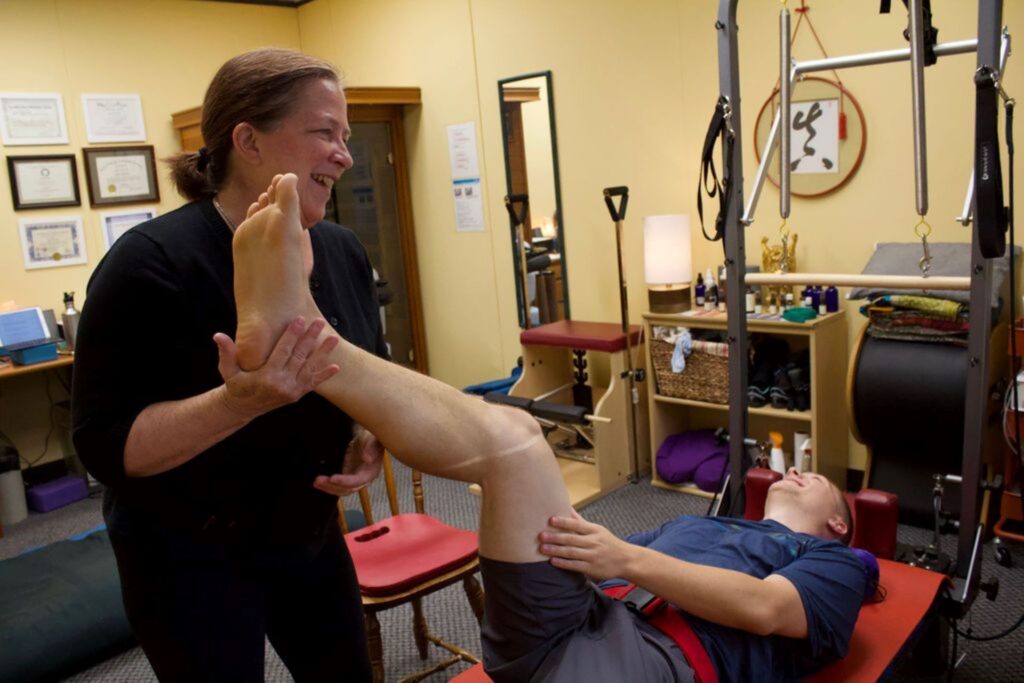
If you need guidance, Infinity Flexibility currently offers in-person sessions at our office in Natick, MA, or you can follow us on YouTube for fascia releases, self-stretches, resistance exercises, philosophical discussions, and more!
Working with Your Meridians
We can work the muscles along the meridian lines to release tension in the fascia. We can release the fascial planes to support our meridians. We can go to acupuncture or Infinity Flexibility for support from a professional.
We can use our diet and lifestyle to support the physical body, which in turn supports us energetically. We can work with the nervous system to practice moving between activation and relaxation.
And we can explore our relationship with strength, boundaries, protection, and self-trust, noticing where these patterns appear in both our physical and energetic bodies.
We are not powerless. The more connections we can see, the more ways we have to create change.
If you’re curious about fascia and the energy behind the meridians, make sure you follow along for the next article in our Fascia and the Meridians series.
Energetics of the Superficial Back Line
